Announcement

Let me know if you are linking this blog to your page and I will put a link to yours.
Showing posts with label Terrorism. Show all posts

Tuesday, November 13, 2012

How Leaders Can Fuel Terrorism


---
How Leaders Can Fuel Terrorism
Yohanes Sulaiman | September 12, 2012


There is good news and bad news about the latest rash of failed bomb-making attempts by the misguided wannabe-jihadists in Indonesia. 

The good news is that their failure means that the government, through good intelligence and increased cooperation with other countries, has managed to disrupt international terror networks. 

Many of the terrorists that caused bloodbaths in Indonesia in the early 2000s, such as the one in Bali, had good connections with the international jihadist network, notably Al Qaeda, that was cultivated in the 1980s, when many of their colleagues or superiors spent years fighting the Soviet Union in Afghanistan. Thanks to the strong connections, they were adequately trained in bomb-making and terror attacks by instructors in Mindanao, in the Southern Philippines, Pakistan or Afghanistan. That made them uniquely skilled in blowing up their targets and causing many casualties. 

The impact of successful training can be devastating. The Americans experienced it firsthand in Afghanistan and Iraq, where improvised explosive devices were used to cause many casualties. The use of IEDs is apparently so successful in Syria that Syrian soldiers reportedly don’t dare to venture too far from their bases, where tanks and other vehicles are vulnerable to attack. The Syrian rebels seem to have learned the art of bomb-making from Islamists that honed their skills in Iraq. 

The fact that the past few years have seen many aspiring terrorists fail in causing mass casualties, or managed to blow themselves up while making bombs, suggests that the international connections have started to dry up. Terrorist networks are not easy to build. There are many difficulties, notably the problem of trust. Who could guarantee that a new recruit is not a mole planted by the government in order to undermine the network? Or, having spent some years in prison, there are always possibilities that a former prisoner would either be closely watched by the police or has become an informant. 

With each successful crackdown on a terrorist network, it is becoming harder and harder for the network itself to maintain itself. This strain showed up in the recent explosions, or premeditated attacks like the ones in Solo. The police, with little difficulty, are managing to crack down on the entire network. 

Many of these people are simply lacking the proper training to handle and manufacture explosive devices, or more importantly, to create a strong organization that could launch deadlier attacks. 

While they can learn the art of bomb-making from the Internet, it is very different from the hands-on training that experienced instructors provided. Building a strong and deadly terrorist network requires a lot of experience, especially in the art of strategy, notably on the question of how and when to attack, to maximize the impact. 

The bad news about the latest rash of failed attempts, however, is that they also suggested that many of the wannabe jihadists are homegrown. It is easy to blame globalization, growing inequality, or the declining respect and adherence to Pancasila as the state ideology that cements the nation together, as the main culprits of the radicalization of our youth. That would be incorrect. It is the fault of irresponsible religious and political elites. 

Religious Affairs Minister Suryadharma Ali labeled the Shia as a deviant sect. By doing this, Suryadharma provided justification for any attacks on the Shia community, while absolving the attackers from blame, since they are attacking the guilty party anyway. 

Similarly, sermons denouncing Buddhists for their attack on the Rohingya Muslims in Myanmar — even though the majority of Buddhists in the world had nothing to do with it — provided a misguided justification for attacks on Buddhists everywhere. 

Not surprisingly, the wannabe terrorists who managed to blow themselves up last Saturday in Depok, West Java, were planning to target a Buddhist center in Jakarta to avenge the Rohingya Muslims. 

What is the right way to handle the rising radicalism in Indonesia? Aside from a strong deradicalization program, the government keeping the pressure up, and surveillance on any suspected terrorist networks, the best answer would be to tell the religious and political elites to stop denouncing others for short-term political gain. By providing justification for further radicalization of society, these people — our leaders — are sacrificing the unity of Indonesia on the altar of selfish personal interests. 


-------
zerodiversity
10:17am Sep 12, 2012
@ Pak Yohannes

The main problem is Indonesia does not have a real leader who places the country welfare in front of his own personal benefits and ambition as well as the political party benefits. Just take a look at how many ministers are allegedly involved in corruption and how many are really doing their jobs. Not to mention the large number of House representatives being absent from meeting most of the time and you have a government that does not work. A government that does not place the country welfare first will result in many people being dissatisfied and easily recruited into terrorism.


Valkyrie
11:06am Sep 12, 2012
Yohannes...

The people will 'listen' when their stomachs are filled and that they can honestly afford three square meals a day. their children would receive proper education and finally reliable medical services for the poor and needy. Short of any of the above, this country will be susceptible to radical influence.

Radicalism thrives on poverty too! It's frightening when we are told that almost 109 million Indonesians are deprived of clean water.

On another thread, I mentioned about the 23 trillion that was allocated for 2012 to cover travels.

The way to the hearts of the citizenry is through their stomachs.


jchay
11:34am Sep 12, 2012
The continuing problem is we let ourselves being put into different boxes (majority, minority, ahmadiya, sunni, shia, christian, chinese, papuans etc etc), and it is used as justification of discrimination or attacks.

When we start accepting ourselves as one: the people of Indonesia, what left is only the case of some criminals attacking or killing the people of Indonesia (regardless religions or race etc), and it is the responsibility of the Government of Indonesia to assure safety and protection for all Indonesian people.


devine
3:49pm Sep 12, 2012
Bpk Yohannes, although I believe the Ministry of Religious Affairs should not even exist it would alternatively be a good to at least extend the Minister with several Ministers, one of each religion. It is a known fact that the current Minister is called the Minister of Islamic affairs... so there should be a balance, either a Minister that equally respects ALL religions or as said above several ministers that should be allowed to speak out only after a common consent is found among them (vote i.e.)...
and jchay: yes! 100% correct, that would be the real solution!


DrDez
6:41am Sep 13, 2012
Some Indonesian politicians (in the name of Sunni Islam) fuel the hatred and therefore support and encourage acts of sectarian violence and even terrorism - and often as we see mob murder - with impunity from prosecution
In most developed nations they would be jailed or at least stripped of office. Ali is one such man - but there are hundreds more
Yesterday we read about attacks on the West because of some movie being offensive to Islam - well here and now many who are acting under the guise of Islam are offensive to humanity ... We in RI are on a slippery slope and our leaders via greed and/or religious motivation have allowed, nay supported their 'brothers' often openly - it is disgraceful - it is a crime
JC - but whilst a good number of Sunni Muslims push a violent agenda what the rest of us accept matters not one bit


Yohanes-Sulaiman
7:35am Sep 13, 2012
Thank you so much for your kind comments.
@Zerodiversity: It is sadly the case. Most of the so-called representatives and officials are more interested in lining up their pockets than to actually serve. Truly a recipe for a failed state.
@Valkyrie: Poverty matters, but not really in this case. There's a study a couple years ago that actually stated that majority of terrorists had middle-class background or even rich people -- one reason, I suspect, is that these people actually have time and opportunity to actually read and think about this issue -- poor people are too much focused on their stomach and to feed their family. In Indonesia, the "middle-class" is a disputed term, so we might have a nice debate on this, but from what I observe from our suspects here, at least they have the ability not thinking how to feed their wives and offspring, meaning that they actually have some resources available, and this not that poor after all.


Yohanes-Sulaiman
7:39am Sep 13, 2012
@Jchay: I blame that on the short-sighted selfish officials that zerodiversity already condemned. If you don't have the ability to govern and can't make a case that you are a good official, the best way to still come ahead is to condemn others as heretics or kafir or whatever it is. It is politics of hate for selfish interests.

@devine: You raised a good point, but I don't think that's workable. Most importantly: the quality of the ministers. How could you expect that the quality of these six(?) ministers are high, when the one we have here is already a trainwreck with the big cheese doing nothing but composing songs?


Yohanes-Sulaiman
8:57am Sep 13, 2012
@DrDez: As long as they only receive a slap on their wrists, these people will not learn.




Thursday, December 22, 2011

Trust Issues

This is my first article in Tempo English Magazine. There was a miscommuncation regarding this article, I thought I was asked to write this by Asiaview Magazine, but apaprently it was Tempo English Edition on October.

As a result, I don't have a hard copy of this article.


--
Trust Issues
October 12, 2011

 THERE is both good and bad news in analyzing the recent religious clashes in Ambon and the suicide bombing that hit a Christian church in Solo.

First, the good news. The incidents show that by and large the issue of religious conflict is no longer popular, society has matured and is now more skeptical than ever before.

Unlike in the early days of Reformasi, when religious clashes in Ambon were met with intensive and uncritical media coverage and politicians jumped onto the bandwagon of religious indignation, demanding to defend the faith, this time everyone called for restraint, demanding the government restore order.

It was probably a blessing in disguise that the last conflict was so bloody and so traumatic to Indonesians’ psyche that this time politicians and mainstream organizations were more mature in handling the incidents. Provocative SMS and Tweets were immediately denounced. The mainstream mass media showed more restraint in covering the incident and people actually criticized coverage that was seen as too provocative. The Ambon incident was able to stay localized.

The same pattern happened in reaction to the Solo bombing. There was an outpouring of condemnation for the act of terror and sympathy for the victims. Rather than being seen as hero or a syahid, the suicide bomber was widely condemned and ostracized.

At the same time, the government did some right things. This time, the government immediately jumped into the fray by sending both police and military reinforcements to the troublespots, thus preventing the conflict from spiraling out of control. By having a large number of forces in Ambon, the government signaled that this time it would not be caught with its pants down and would deter anyone trying to take advantage of the situation.

In the Solo case, the police actually did take the threat of attack seriously and had already sent an officer to guard the church. To be fair, it was more due to an unfortunate personal lapse of judgment than to institutional or intelligence failure that the suicide bomber managed to fulfill his grisly quest.

Yet, at the same time, the two incidents showed some troubling facts. First, religious harmony in many locales is still very fragile. Even though national figures are united in condemning the acts of terror, there remain local officials playing religious issues for political gain, such as most recently the act of the Bogor mayor in closing the GKI Yasmin Church, which has the necessary permits.

With the government unwilling or unable to rein in flagrant abuses of law, this encourages the growth of local-based radical groups. This in turn creates fertile recruitment grounds for homegrown terror groups that fly below the radar, such as the Cirebon group that has twice launched suicide bombings.

Lack of local initiatives due to local politicking also causes the Malino agreement, which ended the Ambon conflict, to be less effective. By and large, the conflict was settled as both sides were virtually exhausted, unable and unwilling to fight anymore, thus the situation was ripe for peace. Yet after the accord, there was no lasting follow-up process to reintegrate the society. The government seemed to only be interested in calming the conflict, rather than creating conditions for lasting peace. Thus, the reconciliation process was slow and haphazard, without extensive official support. The recent conflict showed that tensions between the communities remains high and only the painful memory of previous conflict managed to prevent this incident from exploding out of control as before.

Another thing is that while people can no more be easily provoked, they distrust the government too. This is not out of the blue but a gradual decline that was started by revelations of corruption scandals, official misconduct in the ministries, national and local bureaucracies, parliament, the courts, and law enforcement. Add to the mix the aforementioned religious politicking and it’s not surprising that public trust in the government has steadily eroded.

The distrust accelerated after disclosures that law enforcement agencies may have a direct hand in coordinating the conduct of widely reviled militant groups. As a result, the government is no longer seen as benign and protective. It is now an object of suspicion, its actions open to doubt, and people see it as a possible source of mischief.

So many people have casually speculated that the Ambon incident was provoked by elements within the police, the military or even local politicians. There was even a false rumor that the Ambon incident was too convenient, supposedly coming on the heels of a KPK visit to investigate local corruption. The Solo bombing also sparked allegations that it was just another attempt to distract the public from the swirling corruption scandals currently hitting President Yudhoyono’s cabinet.

Finally, the two incidents show the lack of public trust in the police force itself. In Ambon, the memory of the past clash, where police were seen as taking sides rather than acting impartially, created distrust of the police. Thus when the police were unable to ascertain the sender of the provocative SMS or the real cause of the death of the Muslim motorcycle taxi driver that sparked the current clash, it created the perception that the police were not serious in dealing with the crisis, or worse, on the other side of the fence. Small wonder that the government had to make a show of force by bringing in thousands of police and military personnel to show they were truly interested in maintaining peace and being impartial.

In contrast, Joko Widodo, the popular Solo mayor, who is seen as honest, just and evenhanded, managed to calm the situation by immediately meeting with the local mass and religious organizations to prevent more misunderstanding and suspicions. His leadership is widely praised as helping to defuse tensions and quickly restore conditions to normalcy.

Both incidents show that public trust in the government is essential to maintain lasting peace. In Ambon it took a lot of personnel to maintain peace in places where public trust in the government had been broken. In Solo, however, the situation quickly returned to normal thanks to a strong leadership that is able to maintain popular trust.

Friday, December 16, 2011

Solo Reveals Terrorists’ Power Is Waning, but What’s Next?

This article analyzes the changing nature of terrorism in Indonesia, that moved from Jamaah Islamiyah/Al Qaeda model to loose groupings.
-----
Solo Reveals Terrorists’ Power Is Waning, but What’s Next?
Yohanes Sulaiman | September 27, 2011

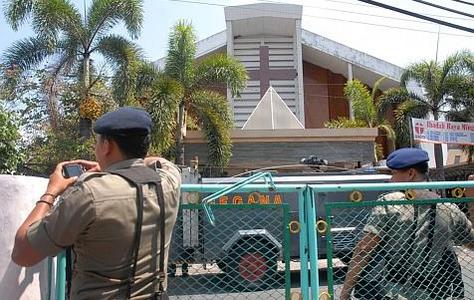
Policemen and their bomb squad vehicle guard the site of an explosion at a church in Solo, Central Java, Sunday. (JG Photo/ Ali Lutfi)
Before people start talking about the ineffectiveness of the national security forces following Sunday’s suicide bombing in Solo, or speaking about the rise of extremism, I would argue that this attack shows that both the police and the State Intelligence Agency have actually done a good job. Thanks to firm action by the government and the National Police’s counter-terror squad Densus 88 in pursuing and hunting down terrorists, the power of groups like Jemaah Islamiyah to stage deadly attacks has declined significantly.

The reason is simple. Terrorist groups are personality-dependent entities. They can’t easily trust others, lest spies infiltrate them. As a result, they recruit and get their funds based on the close relationship between one key member of the group to the other members.

Thus, the reason why Indonesia’s JI has a close connection with Al Qaeda is due to their working together in Afghanistan back in the 1980s and later interaction in Mindanao, the Philippines. Such closeness creates a sense of comradeship, and trust.

As a result, when Densus 88 and the intelligence agency known as BIN managed to eliminate, or at least contain, key people such as Hambali and Noordin M. Top, the link between Al Qaeda and JI was strained. The ultimate coup was the isolation of Al Qaeda itself in Afghanistan due to pressure from the United States.

With JI severely weakened, there are very few people in Indonesia who can recruit and train the new extremists in the art of bombing, let alone finance them.

This weakness was also evident in the most recent spate of bombings. Pepi Fernando, who allegedly sent book bombs to various prominent figures in Jakarta in March, did not receive any training at all. He learned the art of bomb making from the Internet. During interrogation, he actually claimed that he did it in order to get the attention of Al Qaeda, which he hoped would offer much-needed funding and training.

The April suicide bombing of a police mosque in Cirebon bombing and the Solo bombing, while traumatizing, were far cries from the sophistication shown in JI attacks. These involved dual suicide bombings with high explosives and killed dozens or even hundreds of people. In short, the power of JI in Indonesia is ebbing and the recent attacks, to put it bluntly, were caused by JI-wannabes, who would never be able to cause as much damage and casualties as the JI of yesteryear did.

Police unfortunately have not been able to adapt to the changing threat. The new, relatively small and very tightly knit terror groups are difficult for police to infiltrate. It is simply impossible to ensure that there won’t be any more attacks from these small groups without seriously infringing on human rights.

What the police really need is a smarter approach in dealing with suicide bombers.

Political psychology expert Jerrold Post has argued that some terrorists are “lonely, isolated, alienated individuals who find, through the Internet, a sense of community — a community of hatred.” In essence, many terrorists are emotionally disturbed people who are easily influenced by radical discourse that would provide a sense of belonging and purpose, regardless of how twisted it is.

It is tempting to argue that shutting down radical Web sites would be the best way to solve this problem. Yet, as the Americans found out, the radicals would simply move to other sites.

What we really need is to foster a society in which radicalism and suicide bombing are socially unacceptable. Denunciations of bombings by Nahdlatul Ulama and Muhammadiyah are not enough, especially because radicals simply do not listen and pay attention to such mainstream groups.

The first step should thus be at schools. The quality of many religious teachers in schools is atrocious, however. This is reflected in an infamous Institute for Islamic and Peace Studies (LaKIP) survey that noted that 28.2 percent of Islamic Studies teachers were willing to commit religiously or morally motivated violence. A recent increase in the Religious Affairs Ministry’s budget should be used to make sure that only qualified teachers who back pluralism will be allowed to teach.

In addition, allowing groups like the Islamic Defenders Front (FPI) to disregard laws and act with impunity will only give the signal that the government is half-hearted in dealing with extremism. Their radicalism in turn will inspire many misguided individuals to push for more violent actions to “defend Islam” and will fuel the rise of new terrorist groups.

Once the government deals firmly with extremism to promote a pluralistic Indonesia, coupled with better religious education, society will start looking at extremism as unacceptable. This in turn will lower the appeal of such groups and cause their downfall.

Tuesday, December 13, 2011

Missed Opportunity: the US & Indonesia After 9/11

-----
Missed Opportunity: the US & Indonesia After 9/11
Yohanes Sulaiman | September 12, 2011


On Sept. 17, 2001, President Megawati Sukarnoputri arrived in the United States. She became the first head of state to visit the country in the aftermath of the 9/11 attack that shocked the United States and the world.

On Sept. 19, Megawati gave a speech at the USINDO gala dinner. Written by politician Rizal Mallarangeng, the speech was eloquent and hit all the right notes. It stressed the importance of the US-Indonesia relationship, noted that the United States had been very influential in Indonesia and that Indonesia had a strong strategic importance with the country. It reminded the United States that Indonesia was a newly democratic country that had the largest Muslim population in the world and that it would be critical in maintaining regional stability and would be very important in America’s future “War on Terror.”

More important, Megawati stressed that despite the United States’ military embargo that had crippled Indonesia’s ability to defend itself, Indonesia was willing to help the United States in times of need. The help, however, was not free. Megawati commented on the challenges facing Indonesia, notably its limited resources and its own internal troubles of a financial crisis, corruption, separatism, GAM-led terrorism and ethno-religious conflicts that would hamper its ability to contribute to US interests — implicitly demanding some sort of quid pro quo.

Such a demand was not unethical. Rather, it is common in international relations that the stronger state, in this case the United States, should bring something to the table in exchange for support.

And the potential payoff for Indonesia was enormous. The United States could pressure its allies to stay out of Indonesia’s internal affairs; it could throw in a lot of much-needed economic and technical assistance; and it could lift the arms embargo on the Indonesian armed forces, accelerating their modernization. There were also trade concessions being dangled.

And there was reason to expect this kind of massive payoff. In October 2001, Frida Berrigan, a peace activist and research associate at the World Policy Institute who was not a fan of US-Indonesia rapprochement, complained in the World Policy Journal that President George W. Bush “promised Megawati economic aid totaling more than $700 million, including money for police training and civilian courses in defense under the E-IMET program [Expanded-International Military Education and Training]. Bush also expressed his desire to resume regular military contact, and lift the embargo on the sale of ‘non-lethal’ weapons.”

In essence, Indonesia would have received much of what it wanted from Washington without too much hassle or arduous negotiations, simply because Indonesia was in the right place at the right time.

Unfortunately, the Indonesian political elites did not think of the long-term interests of the nation, instead focusing on their own short-term interests and as a result blowing a once-in-a-lifetime opportunity.

After the United States began bombing Afghanistan, Indonesian political leaders raced to condemn the action, simply to court the fabled “Muslim vote” that would supposedly bring an absolute majority in the legislature. Vice President Hamzah Haz demanded that the United States end the hostilities in Afghanistan. Not surprisingly, faced with political pressure, Megawati quickly backtracked from her position of support for the United States.

Thanks to this, many of the offers that Bush put on the table were withdrawn. It was not until 2005 that the military assistance to Indonesia was partly carried out, and it was conditional on a yearly evaluation by the US secretary of state of conditions in Papua.

In 2008, the US foreign aid request for Indonesia was just $185.6 million. In contrast, Pakistan, which publicly opposed the US invasion of Afghanistan and covertly supported the Taliban, but allowed the United States to use its airspace to invade Afghanistan, benefited greatly from this double game. According to the Congressional Research Service, the United States waived nuclear weapons sanctions on Pakistan, rescheduled the country’s debts and provided both official and unofficial foreign aid totaling $20 billion.

In the meantime, in spite of Haz’s bold assertion that there were no terrorists in Indonesia, Jemaah Islamiyah struck Bali with car bombs, killing 202 people in 2002. The bombing crippled Bali’s tourism for years, depriving Indonesia of much-needed income.

The tables were turned. Instead of Indonesia demanding payment from the United States for its cooperation, Indonesia had to ask for US assistance in its own “War on Terror,” helping the United States to fight its war without gaining as many economic benefits as it could have.

For Megawati, the Bali bombing inadvertently spelled the end of her presidency as it presaged the ascension of Gen. Susilo Bambang Yudhoyono, who in the aftermath of the bombing managed to show his leadership, his command and control of the situation. This later ushered him to the presidency, as ordinary people yearned for bold and decisive leadership, a proverbial stonewall in the middle of chaos caused by the greedy political class.

Ten years after 9/11, Indonesia’s internal situation is vastly improved. The terrorist group Jemaah Islamiyah has been decimated, major ethno-religious conflicts are no longer seen as inevitable as people mature and understand the stupidity of such conflicts, and the country’s economy is growing.

Sadly, however, Indonesia’s political elites remain mired in their old ways of thinking, preferring political posturing in order to score short-term political gains, rather than doing something bold and decisive, and focusing on the long-term interests of the nation. Such thinking robbed Indonesia of its once-in-a-lifetime opportunity. It won’t be surprising if there is an encore.
---------


jchay
4:27pm Sep 12, 2011
Until Indonesia has a leader with the best interest for the nation, people and its resources instead of "selling" them out for the sake of their own short-term interests, we will keep reading this kind of historical stupidity.


DrDez
5:21pm Sep 12, 2011
66 years Yohanes - its shameful. We are one of the richest nations on earth regarding natural resource and with a population size that could exploit it for the benefit of the whole nation - but instead we choose greed and conflict


Valkyrie
6:41pm Sep 12, 2011
DrDez:

I am going an inch deeper into my thoughts as to why, Indonesia is not able to become a solid economic nation.
Wikileaks is just toying around the surface. Like you, I have been too long in this country not to notice strange situations.
Tell, you what. When this country is free from external religious influences and the next generation has amassed adequate education, change will take place.
Right now "someone" outside seems to look at Indonesia as an unstable entity.
Think about geopolitics and you'll see what I mean.


Ppar512
11:36pm Sep 12, 2011
I disagree with this article. Except with the sentiment that our leaders are and were incompetent. But i think in this instance they've done the right thing.

With hindsight, I couldn't understand how anyone could argue that supporting US wars in Afghan & Iraq is the right thing to do. I'm even confident that the majority of US citizens now, after seeing the cost and facts would've chosen to go to war in the first place. Afghan is a failed state now, US casualties everyday. And for what? Bin Laden is killed in Pakistan, with intelligence work and covert ops, not full blown assault. Iraq? All evidences points to WMD alert as full-on fabrication. Cant see any defensible reasons for this war except oil or post war construction jobs.

And just look at what standing fully behind the wars leaves Blair and Howard and their respective parties? What good has it done to them? So how can you seriously advocate it now in all times?

As for playing a blatant double game in supporting what amounts as illegal invasion bordering on genocide? I do wish we dont have to resort to despicable acts like that and still maintained what left of our semblance of dignity. Money can be found elsewhere but honor is apparently scarce in this modern world.


jetset24
6:02am Sep 13, 2011
Too many missed opportunities since Indonesia's independence. Sorry to say that their history wasn't fed with a silver spoon therefore why not take today the opportunity (providing there is still a chance) and excel while burying away the egoistical attitude on every level.


Yohanes-Sulaiman
6:23am Sep 13, 2011
Thank you all for your comments.
@Valkyrie: The problem, unfortunately, is the quality of education itself is suspect. As you may notice in today's Globe, grafts robbed many schools of its desperately needed funds. Now, politicians found that they could increase the money for the Ministry of Religion, and calling it "fulfilling the constitution that mandating 20% of state budget for education" even though this ministry has far worse records on grafts.

On geopolitics, I know who you mean, but don't think I should speculate about their motives, etc.


Yohanes-Sulaiman
10:13am Sep 13, 2011
@Ppar552:

On "genocide," I am sorry but I think you are using that term too liberally. Genocide is a state's OFFICIAL policy of exterminating a group of people based on their race, ethnicity, religion, or other characteristics.

As much as I disagree with Bush, I have a hard time finding any of his policies that we can safely call "act of genocide" and I am already giving "genocide" here a very loose definition.

In fact, your claim of "genocide" actually looks silly, compared to what the Talibans did or Saddam's gassing the Kurds.

I do think that Iraq was a bad policy - they severely underestimated the difficulties of nation-building. Afganistan, however, is a problem of neglect, coupled by the fact that Karzai is simply a weak and corrupt leader. Bush paid too much attention on Iraq, and allowing the Talibans to regroup - not to mention helps from Pakistan; thus making it a failed state.

It is not black and white- even before Bush's invasion, Afghanistan already a failed state ruled bu fundamentalist cult that treats women like dirt and will be used by Pakistan to launch a proxy war against India and may destabilizing the region. At least the US tried to do something good by building infrastructures etc. Did you know that the US is far more trusted than any local official in Afghanistan today?

I do think that counterfactually, had Indonesia been involved, we could have done many things, trying to influence the events there thus minimizing the messes that the US did. More importantly, however, it would help bolstering our own anti-terrorism program, thus avoiding the Bali Bombings. Still that's a counterfactual and I have to admit that it is my speculation only.

Anyhow, we can agree to disagree here. Keep in mind, however, that there's no morality in international relations. It is all based on interests and morality is only used to justify the means.


SirAnthonyKnown-Bender
11:17am Sep 13, 2011
Genocide is genocide, no matter what any official policy is YS. You can't sell genocide to the American people under a nominally democratic system so it becomes a case of who controls the labels and, most importantly, the consent manufacturing media. In the Vietnam war, Henry Kissenger demanded attacks by "anything that flies on anything that moves". This is as an overt a call for genocide as can be imagined. Of course these transcripts were not released until 25 years after the fact, I wonder why? It's been argued that if the Nuremberg principles were rigidly applied, every US President since WWII would have been hanged. If you want to reduce terror in the world there's one very easy way to do so: stop participating in it.


Yohanes-Sulaiman
12:29pm Sep 13, 2011
Sir Anthony: I don't like the term genocide - it is mostly used as a strawman to simplify others' argument while and thus rather than debating the fine points, just ended up in a shouting match. Besides, why post WWII? I can make argument easily about the US committing genocide on Japan and Germany in WWII, and every single state doing horrid things to others - the Mongol Conquest came to mind. Thus, when will it end? Then it will open tons of cans of worms of holocaust enabler, the "willing executioner" and "innocent bystander" theory.

Let's stick with the facts: the US was in Afghan in order to flush Al Qaeda out. I'd argue that it was a just and necessary war: you keep AQ alive, it will be emboldened and keep funding other terror attacks, notably the Jamaah Islamiyah. There are some reports stating that the reason why JI stopped fighting in Molucca and Poso was due to their fund dried out and AQ egged them to have another strike, thus you have Bali.

Iraq, however, is an unnecessary war because Saddam was contained and they didn't think too much about nation building, not to mention distract from the real objectives: Al Qaeda and Taliban.

You want to stop terror? Cut the head and make sure you de-radicalize the rest.

Anyway, I have to say its a nice comment. I'd love to hear your reply. Thanks!


Valkyrie
2:39pm Sep 13, 2011
Yohanes,

I am thoroughly enjoying your articles/postings. Thanks to "enakajah" who told me about you. He was correct.

Cheers!


Ppar512
4:51pm Sep 13, 2011
Yohanes-Sulaiman: I apologize for the improper use of genocide. My mistake. Thank you for the correction.

Obviously you know far more about politics than me so I instead would like to ask for your opinion in my scenario of what ifs. In my belief if Megawati is steadfast in her support for the US wars wouldnt her opponents with the increasingly unpopular wars pounce on that and amass support in the house to oust her? At best she would last until 2004 and lost anyway, cause the wars are already extremely unpopular then, and she wouldve been labeled as the one who supported it.

And I do agree that morality is only about perception. But your proposal of double game is in my opinion would be unpopular enough to cause enough disturbances in this country to make the gain moot and even be counter-effective.

Another question, do you not think that your confidence in our power and standings in international relation is exaggerated? If we do as you proposed, are we really able to have enough influence to impose ourselves to change the course of history?

Lastly, you described Yudhoyono as a bold and decisive leader. In his first term, all evidences points to this. But why is it that in his second term, even with added advantage of people majority support, he seems to be the antithesis of that? What contributed to this stark differences? Is there an X ingredient missing now?

Thank you for the informative argument. Apologies for my lack of cohesive reply.


SirAnthonyKnown-Bender
5:03pm Sep 13, 2011
As Britain found out in Northern Ireland and umpteen attempts at reducing terror since, cutting the head off just leads to more terror as a response and new leaders springing up in the beheaded terror leaders' place. It's more like cutting the grass...it keeps growing. I don't buy the line that you declare war on an entire country in order to flush out a small group responsible for one specific crime. Obama has increased the onslaught on innocent Afghanis if anything and for what? As soon as the US pulls out the so-called democratic government of Afghanistan will collapse within 48 hours. Democracy emerges from some inner will and impulse of the people and cannot be created by an annexing, Imperial power. Iraq, on the other hand, has been radicalised in a way it wasn't before and the Middle East is now shaping up for a Shia/Sunni conflagration that'll destroy any hope of peace for a generation. These two countries have been pretty much ruined by wars of aggression dating back decades, wars that the West have been complicit in and waged. The Taliban were US favourites until they fell out of favour. Iraq was shattered by bombs, then sanctions, then bombs again. It's inconceivable that America will allow an independent Iraq, but they simply haven't known what the hell they've been doing and are now left having failed in their one war aim: namely to make sure that Iraqis don't rule their own country. Under international law, all the consequences of these wars are the responsibility of the aggressing party, to wit, the US and its allies. The Middle East is the world's great energy prize and the West wants its hands on the spigot, it's as simple as that. The 9/11 bombers were all from Saudi Arabia - the country that has a growing fundamentalist terror problem and which is, at a deep level, the most fundamentalist religious country in the world. They're the US's allies. These are the facts. Just war? The West needs its "just wars" it distracts attention away from other stuff, such as Obama appointing people to clean up the financial crisis who were responsible for causing it in the first place.


Orangjkt
6:36pm Sep 13, 2011
Merican bule got bombeb because of their fault. Their habit of being nosy and arrogant caused 9/11, we didnt need to feel sorry for them...they deserved it. How many peop,e has the american killed in iraq,vietnam,afghan and so on? Hundred of thousands!!!


Roland
8:57pm Sep 13, 2011
@Orangjkt! Your "opinion" that they deserved to die is a very sad reflection of your very own humanity against others..
Innocent people NEVER deserve to be killed and this includes also all the civilian who got killed in Vietnam, Afghanistan, Iraq, Japan, regardless on who killed them. It wasn't their fault as it wasn't the fault of the victims of 9/11 to be (mostly) US Americans. It is simply wrong! Your excuse of making it right by adding assumed attributes as "nosy, arrogant" to their character does NOT contribute in your direction!
I pity you and your cruel mindset!


Yohanes-Sulaiman
10:21pm Sep 13, 2011
Hoo boy, this will be a long night for sure, trying to answer such great comments. I guess next time I should write something as polarizing as this one. September 30 comes to mind, but well, let us digress.

@Valkyrie: Thank you so much. Say hi to enakajah for me. I haven't bugged him in ages because I believe he is pretty preoccupied with his current project.

@Ppar512: I don't know you, so it is possible that probably you know more politics than I do. Ok, lets move on to your questions:
1. Keep in mind that I don't entirely blame Megawati for missing the opportunity. If you re-read my oped, I blame the immature Indonesian political elites, who prefer to focus on their short-term interests than thinking the long-term interest of the state.

Honestly though, even if the parliament would try to get rid of Megawati, I doubt that in 2002 there was a viable alternative to Megawati. Gus Dur could be replaced because there was Megawati whom everyone agreed to be able to replace him. Hamzah Haz? Yeah right. Amien Rais? Possible, but don't think he was that popular. Even the rise of SBY was to some degree very unexpected.

So, back to your core argument: aside of SBY, who would be that popular in 2004? Even in the hindsight, I could name nobody.

2. Could "bad" foreign policy caused disorder? Call me cynical, but I'd guess probably just the usual suspects who would cause havoc, people who are paid to cause havoc. Other than that, call me cynical, but regular people simply don't care about foreign policy.

Since Indonesian independence, foreign policy had always been used as a club to beat the political opponents - thus Hatta's famous 1948 speech on "Bebas Aktif," which was essentially him trying to preempt the attacks from the leftists who were pissed off that he was so close to the United States. Yet, should the elite be united, there were no ruckus at all about "biased" foreign policy.

You can ask Suharto for that in regards to East Timor. Even Sukarno did not do anything when Sukiman signed the Mutual Security Act with the United States, until the Masjumi brought that as an issue to bring down the Sukiman cabinet as a payback for the collapse of the Natsir Cabinet.

3. Well, I will use the usual cliche: we are strategically important, in the middle of two oceans and two continents. Thus, geographically Indonesia has always been critical. In fact, there would not have been US involvement in Vietnam had there been no Commies in Indo. Nixon would not have withdrawn from Vietnam had Indonesia been a communist country.

Powerwise, however, Indonesia is weak - thanks to decades of authoritarianism that destroyed the ability of the military to think critically and nepotism that destroyed professionalism. Not to mention the fact that the budget for the military is very low,

Allying with the US would help us modernizing our army and thus increasing our power. In short term, we would still unable to change the course of history or influence the global balance of power, but in a long run, I am crossing my fingers.

4. On SBY: before the first term, he got nothing to lose. In his first term, his popularity was ok, but his power in the parliament was not that high. He had to take risks. In second term, however, he got the power and popularity, and some people even said that he was hoping to build a dynasty. Thus, when you are in good position, you tend to be risk-averse. It is Prospect Theory 101. There was an article about Prospect theory in Kompas a few months ago, but you should not read it. It was horrid and wrong.

In short, he no longer feels the need to take a risk. Then again, it becomes his downfall, and you know, that kinda reminds me of Obama after his "Obamacare victory." There's an interesting parallel between these two.

Thanks for your interesting comments. Sir Anthony is next. Stay tuned.


Yohanes-Sulaiman
10:48pm Sep 13, 2011
@SirAnthony:

You raised lots of great examples, but sadly those examples could go both way.

There's a parallel between Northern Ireland and Afghanistan, where the leaders of the extremists could go across the border for protection. That what made it very difficult to cut the head. You have safe havens to regroup, restock, and to make plans.

Of course, the assistances are unofficial, but they do wonders in making your anti-terrorism policies ineffective.

Keep in mind that the US never declares war against Afghanistan, but only Talibans, who were not popular at all, and they could only survive thanks to the Pakistani's intelligence service's support.

I am not a fan of Obama, mind you. I think he is an overrated empty suit. Still, he didn't target innocent Afghanis. He targetted the Talibans.

On Democracy, you must be kidding. While the US did share some blame for messing up the place, the majority of the blame should be put on Karzai, who manages to create an empire of kleptomaniacs. Had he been a better leader leading a responsible government, he would have been very popular indeed. Corruption is Karzai's wrongdoing and he had to live with it. You can't blame US for that.

Actually, making democracy is easy. Suharto has been doing it nicely with his elections. Improving the quality, however, is a tough job, because you really need to have credible and capable political elites who would think the long term interests of their nations, like Bung Hatta.

On Sunni-Shia conflagration: you know what, I don't buy this entire idea of ancient ethnic hatred. These people had been living there for centuries nicely, even with the Jewish and Christian populations.
The problem, however, is when you have idiotic thuggish elites who want to rule the state by using religion as his or her sole selling point.
WHen you have a bunch of thugs under a Shiite leader start beating a bunch of SUnnis, the Sunnis would of course be upset and would rely on fellow Sunnis to settle the score.

Once these kind of people were out of picture, you won't have any more religious conflicts. Ask the Germans who had a 100-year religious war back in the days. Today, seemed to me both their Catholics and Lutherans are getting along nicely.

On Independent Iraq: I think you better ask Syria, Iran, Turkey, and even Saudi Arabia. They are the ones who are hoping that there is no independent Iraq. For US, the sooner they leave, the better as Iraq is so costly.


On oil: do you realize that the US gets its oil from Venezuela, Mexico, Canada and Nigeria? It is the Japanese and Europeans who got their oil from the Middle East, including Iraq.

On consequences of war: I think the US had done a good job trying to fix what they broke. Well, it is not their fault that the local elites are not mature enough to act responsibly.

In essence, true, part of the blame is to the US. Yet, you can't really blame everything on the US. It is a two-way street, and seem to me that the irresponsible locals also share part or probably the majority of the blame.

On Obama's just war: meh, I am not going to defend Obama. Wake me up when he got kicked out and Hillary or at least Romney got in.
If it is Perry, four more years of winter. If it is Bachmann, better bring ski to hell.


@Roland: hear, hear!


SirAnthonyKnown-Bender
3:20am Sep 14, 2011
“On Democracy, you must be kidding. While the US did share some blame for messing up the place, the majority of the blame should be put on Karzai, who manages to create an empire of kleptomaniacs.”

Seriously? You blame a Washington stooge for the mess of Afghanistan? How is a man such as Karzai, a Western puppet, supposed to project power in a land of perpetually warring tribes? As I said, democracy, representative government, call it what you will, comes from an inner impulse of a people of a given country and cannot be imposed from outside, and Afghanistan is the paradigmatic case. It’s pure Western hubris to think that these populations just can’t wait to set up there own versions of America’s by now extremely corrupt form of government. Karzai’s power extends to the edge of Kabul and that’s it, he’s not a credible leader but he’s the West’s man. Nobody else is going to toe the imperialist line.

“Actually, making democracy is easy. Suharto has been doing it nicely with his elections.”

Well now we get down to the nitty gritty. If you consider this chap to be a virtuous supporter of democratic ideals and not one of the most vicious tyrants of the 20th century then we really are in trouble.

“…because you really need to have credible and capable political elites who would think the long term interests of their nations, like Bung Hatta.”

He was a socialist, as were all of Indonesia’s founding fathers. Suharto stopped all of that and turned this country into a Western client state: small domestic elite who control the resources and labour and who allow the first world to plunder exactly what they want. What popular movements here can rival those of South America? Where’s the labour agitation? Compare someone like Bakrie with Brazil’s Lula. You may not agree with everything he did but he was a working man propelled to the presidency by the people. In Indonesia today such a thing would be inconceivable, despite both countries being at a similar level of development.

“On Sunni-Shia conflagration: you know what, I don't buy this entire idea of ancient ethnic hatred. These people had been living there for centuries nicely…”

These people have been ruled down the barrel of a gun for decades. Now Iraq has collapsed, thanks to the West, a huge population of Sunnis have been released to face off Iran’s Shia majority. These two countries fought a war and Iraq’s Shia minority (well, around 50 percent) have strong links to Iran. Some of the worst Sunni/Shia violence ever has come in the wake of the US invasion. The prognosis is not good on this front.

“Well, it is not their fault that the local elites are not mature enough to act responsibly.”

Again, we get to the crux of the matter here. Why are elites the sole guardians of their country? What of the people? Of real democracy and popular activism? The answer is they are just scum who have to be controlled and managed while the country is plundered. Look at the Arab spring. It follows the usual model of Western diplomacy. The West backs the dictator until it becomes impossible to continue to do so due to popular foment. They then make fine, noble noises about “democracy” and “the will of the people” while working hard behind the scenes to make sure that as much of the old regime stays intact as possible. There are people who think they own the world Yohanes, and they are going to try their hardest to keep it in their control.


Valkyrie
6:53am Sep 14, 2011
Yohannes,

I am not able to communicate with "enakajah" at the moment. He's incommunicado. (where he currently is, at least)
I know that he'll certainly return when it's all over.


Yohanes-Sulaiman
9:49am Sep 14, 2011
Wow what a fun morning.

@Valkyrie: yeah he is in an undisclosed location. I'd hazard to guess that he is accompanying Dick Cheney? :D

@SirAnthony: interesting comments.

I am serious in blaming Karzai and his ilks. He is not a complete puppet. He has a choice of running a regime professionally. He chose instead to run his regime with his cronies. To say he is a complete puppet is oversimplifying the reality of situation there.

You may want to check some articles written by Ahmad Rashid, a Pakistani journalist on that. There are many more papers written on the limit of US influence on Karzai regimes.

Still, it is interesting when you argue about the "inner impulse" of people, because if you think about it, then there is no such thing as "democracy" because every single revolution, including the US Revolution, is done by a group of elites who then impose democracy on people. It is only after years of internal transformation then a system can truly become democratic.

Similarly in South America. Throw in bread and circus to people, bribe or terrorize political elites, mobilize people with unsustainable welfare state, and voila. Chavez been doing it using his bread and circus. Lula been doing it too, though he is not as blatant as Chavez - he knows very well that he might scare away investors and seeing how well such scare tactics serve Chavez, Lula is smart enough not to repeat it. Yet, corruption is very high there. You can ask Dilma who has to sweep the mess.

So if that's the case, why do you even take offense when I am half-seriously said, “Actually, making democracy is easy. Suharto has been doing it nicely with his elections?”

Of course we all know that Suharto's democracy is very flawed (though the fact that today there are many people truly want to return to that era is very troubling indeed). Still, it did follow every single "demands" of democracy, notably as a way to represent people's will.

Suharto did take this very seriously, he was watching the percentage of voters choosing PDI and PPP and surmised that meant the disatisfaction to his regime was increasing. In places where the dissatisfaction were high, he replaced the leaders. Sounds like working pretty well for me! :D

Though, counterfactually, what if in 1980, more political elites decided to join the Petisi 50? What if Benny Moerdani's discontent was joined openly by other generals? What if their pressure managed to make Suharo resign in 1983, 1988 or 1993?

It is a counterfactual, but I am saying that it is possible that Suharto's democracy could evolve, especially had the political elites back then got their acts together.

Suharto was not Stalin or Mao. His soft authoritarian allowed limited discontent and some choices on the political elites. Still the elites remained with him because it was profitable. People did support Suharto because he gave them bread and circus and stability. Go to villages today and you will find that surprisingly he is still very popular!

On Sunni and Shia: here's my question. If these people hate each other so much, why they were able live together for centuries? Think about it. If I don't like other religion living next to me, I could expel them like the Spanish did in Reconquesta.

The answer: states' manipulations, notably the interests of Saudi and Iran and the influence of power-hungry local elites.

Like it or not, majority of people are apolitical. They don't give a damn about politics and they are only concerned with their daily lives - including all your Lulavistas in Brazil, what they care about are bread and circus. So, yeah, I am actually agreeing with you.

Still, it is important to understand that people do and will change. In the US, the elite-based democracy then slowly evolved to liberal democracy of today with suffrages and emancipation. Democracy, in essence, is providing a choice for people who will slowly learn to pick a better leader.

The speed of learning, however, is influenced by the political elites because they have the ability at present day to change the game. Thus, I am blaming Karzai for wasting this opportunity.

Meh, hope this makes sense.


Valkyrie
11:30am Sep 14, 2011
Yohanes,

Hey! You're sharp!..., but sorry I was told of his whereabouts in confidence.
----------------------------------

"It is only after years of internal transformation then a system can truly become democratic"

As long as Religion permeates Politics, I do not believe "true" democracy can be achieved. The other thorn on the side I can see is the ever present feudalism.

You mentioned "petisi 50." I was around then and I was very close to one person (four star, not BM)) who could easily have removed Suharto.(enakajah and I discussed this in lrngthy detail, actually) However, being a true blooded Javanese he couldn't make himself support P-50.
BM was a Suharto loyalist even after the so called "de-benny-nisation". Thus, it was thought if P-50 had a Judas Iscariot amongst them.
Well, the rest is history as you know it too!


Yohanes-Sulaiman
12:16pm Sep 14, 2011
@Valkyrie: he told me too, so no worries. All I can say is that he is somewhere over the rainbow. :D

Petisi50 was an opportunity lost for early Indonesia democratization, so yeah it was a huge shame. I got the info from different person. It"s a small town anyway. :D

On religion: I agree, but until the govt and political elites are mature enough to understand that excessive and blind involvement of religion and fundamentalism in politics brings nothing but long term grief, I'm afraid it will always be a problem until people get sick of it and wise up and begin the secularization of political life.

BTW, Valk: Are we getting paid for putting juicy gossips and long replies like this? :D


Valkyrie
3:05pm Sep 14, 2011
Yohanes

Personally, I am grateful to JG for the opportunity to express my opinions and let off some frustrations. I guess this is adequate reward for my efforts. Yes, I can tell you were pulling my leg on that one.

You know, I met BM once during a social gathering and found him a cocky sob. Loves to fight and shoots from the hips. But, he proved himself with that rescue operation in Thailand.